Vetiver in Rarotonga, Cook Islands: Researching alternative solutions to wastewater management, erosion control, and slope stabilisation
Vetiver in the Cook Islands: Researching Alternative Solutions to Wastewater Management, Erosion Control, and Slope Stabilisation for Rarotonga.
A Kirkwood, 2019.
[www.islandbooth.com/comm/vetiver-rarotonga-cook-islands.html].
Compiled by Andy Kirkwood.
Contact: [firstName] @ islandbooth.com.
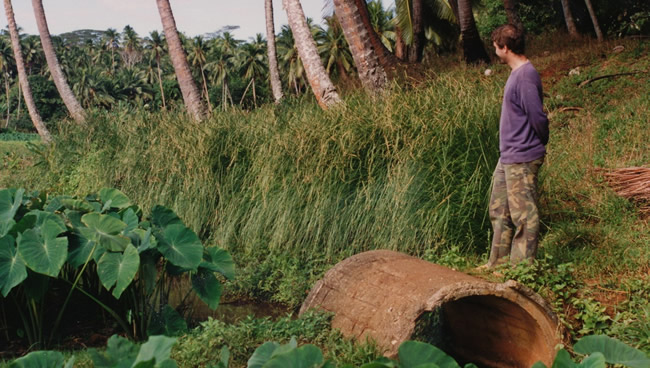
Masthead Vetiver System application in Atiu circa 1992. Grass used to prevent siltation and organic matter (including coconuts), from entering central water source. Photo: Don Miller, DSIR.
Published 23 May 2019. Updated 21 Sept 2026.
From 2017— Rarotonga, Cook Islands is the site of a number of large-scale transformative infrastructure projects, including water supply, roading, stormwater management, and wastewater treatment. How we approach these projects will have a long-term impact on the health of our community — and the health of our island. Vetiver grass is central to a number of nature-based solutions.
Vetiver Grass – Chrysopogon zizanioides
The variety of vetiver grass used for bio-engineering is also known as Sunshine (United States), Khus (India), Monto Grass (Australia), Moras/Mura/Mora (Phillipines), and Muskus (South Africa). [6]
Vetiver grass (Chrysopogon zizanioides L.) is a fast-growing, deep-rooted plant that has been used internationally as a low-cost, environmentally-friendly alternative to concrete-and-steel (‘hard’) engineering solutions. The grass is the foundation of the Vetiver System (VS), researched and sustainable method of addressing agricultural, infrastructure, and environmental management challenges.
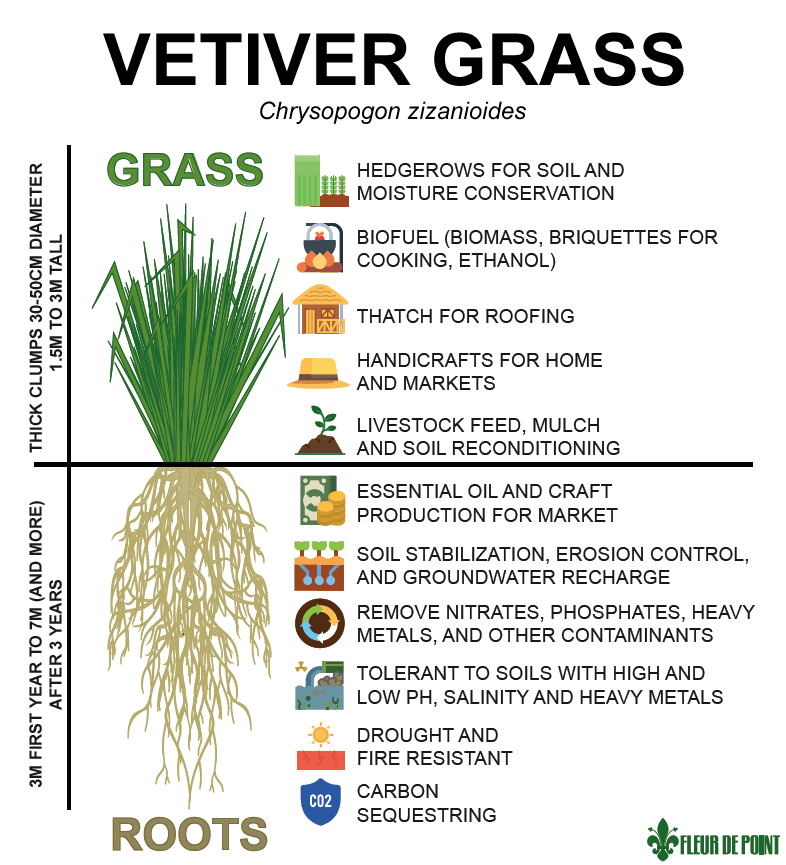
Vetiver grass for green bioengineering applications (Enlarge).
Source The International Vetiver Network / Fleur de Point.
Vetiver in the Cook Islands
Vetiver was introduced to the Cook Islands to the island of Atiu as a source of perfume for massage oil [1], then propagated in response to siltification of the central fresh water source. [citation needed]. It has also been used as erosion control in the makatea (fosilised coral) islands of Mangaia, Atiu, Mauke, and Mitiaro [2].
In the capital island of Rarotonga:
- The grass was propagated from Atiu and Mangaia and promoted to the public in Rarotonga by the Ministry of Agriculture and National Environment Service as part of the Lagoon Day community-led environmental-awareness initiative (2008-2015).
- Infrastructure Cook Islands have planted-out the verges of unsealed road as erosion control.
- With the assistance of students, The Ministry of Agriculture (Teariki Matenga) planted out a residential site in Muri demonstrating the use of the grass to stabilise cut-slopes.
- The grass has also been used along the wetland/stream areas of the Muri and in Titikaveka to protect residential and tourism properties against coastal lagoon storm surges.
- Sections of the road to Papua Intake / Wigmore’s Waterfall as drainage/slope stabilisation.
- A steep bank at the back of Tereora College was planted to stabilise an area prone to erosion and groundwater seepage.
- Vetiver is proposed as a disposal field crop in plans for a reticulated septic system for the developed Muri area.
- Cook Islands Ministry of Agriculture have a modest nursery for supplying slips (June 2019).
- Avana Vetiver is a Vetiver System consultancy, nursery, and applicatio demonstration site located in the Avana valley, Ngatangiia, Rarotonga.
As an alternative to concrete-and-steel reinforcing of slopes, the use of vetiver has significant environmental benefit. Beach sand is not required (as aggregate for concrete block), the stabilisation gets stronger as hedgerows mature, and the root system performs dual duty as drainage/infiltration.
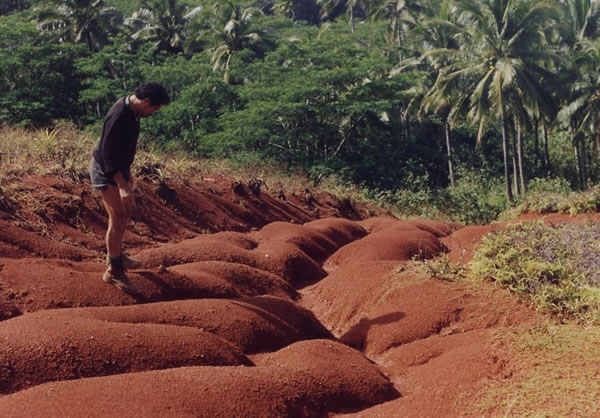
Vetiver rehabilitation site Mangaia, circa 1992.
Vetiver was proposed to remediate heavy eroded pineapple beds areas in Mangaia (above); and to intercrop with proposed coffee and forestry blocks. Photo: Don Miller, DSIR.
Vetiver Solutions for Rarotonga
The way that vetiver grows make it suitable for a range of uses.
- Surface erosion protection. Dense leaves slow waterflow (this reduces rutting). The leaves trap and hold sediment and organic matter; preventing organic material from entering and obstructing waterways.
- Drainage. The deep-penetrating root system (with growth of 2-3m in the first year), improves infiltration. Surface water meeting the base of the leaves is directed into the ground; down the root path. The root system is also highly absorbent; in ideal conditions 1kg of dry shoot biomass (foliage/leaves) will utilise 6.8L water/day [3].
- Protection of catchment areas used for drinking water supply — prevents sediment and organic material from entering waterways.
- Filtering and biological treatment of wastewater (septic/effluent). Rapid growth uptakes a large volume of fluid and nutrient. Beneficial bacteria and microbes contain/process/remove harmful chemicals.
- Coastal erosion protection: vetiver is salt-tolerant (although must be planted above the high-tide mark) and can survive regular exposure to sea-water from storm surges. Roots stabilise erosion-prone areas such as sand banks/dunes and foreshore areas.
Addressing environmental management challenges
In 2022, The Vetiver Network International (TVNI) published a review of Vetiver System applications in the Cook Islands [7]. This located community-led initiatives in the context of environmental management challenges facing small island developing states (SIDS).
Featured are:
- Developed infrastructure buffer: enhancing the operation of drinking water treatment infrastructure; septic wastewater disposal; and safeguarding biodiversity against contamination (drinking water residual / chemical sludge). (Te Vai Ora Maori)
- Riparian planting: restoring biodiversity; containing developed nutrient and sediment sources. (Muri Environment Care)
- Coastal protection: stepped geo-textile seawall with coastal planting reinforcement. (Te Ipukarea Society)
- Cropping system: vetiver for organic food production; rainfed farming. (Natura Kuki Airani - Cook Islands organics movement)
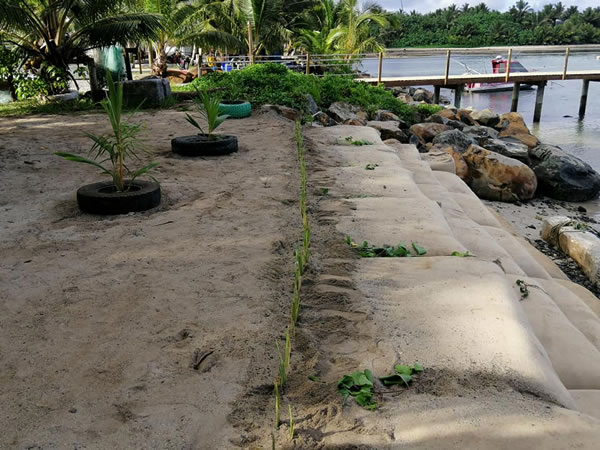
Coastal protection Avana/Ngatangiia Harbour
Geotextile stepped seawall with vetiver as pioneer plant and first line of defense against over-topping.
Source Te Ipukarea Society
The Vetiver Network International (TVNI)
Research and promotion of the application of vetiver systems is championed by The Vetiver Network International enabled by an active social network and the TVNI Facebook Group.
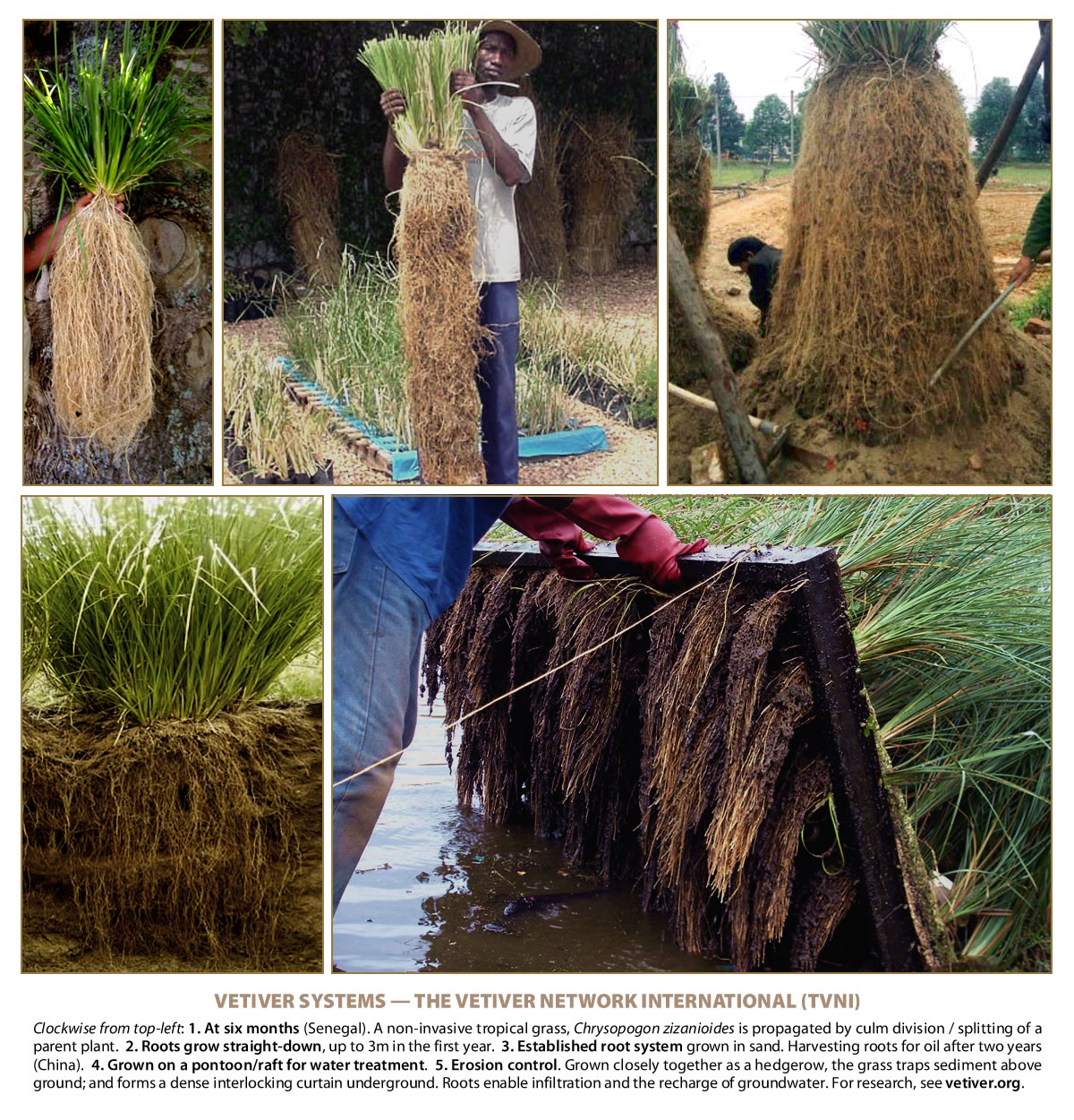
Vetiver morphology and applications
Clockwise from top-left: 1. At six months (Senegal). A non-invasive tropical grass, Chrysopogon zizanioides is propagated by culm division / splitting of a parent plant. 2. Roots grow straight-down, up to 3m in the first year. 3. Established root system grown in sand. Harvesting roots for oil after two years (China). 4. Grown on a pontoon/raft for wastewater treatment. 5. Erosion control. Grown closely together as a hedgerow, the grass traps sediment above ground; and forms a dense interlocking root curtain underground. Roots enable infiltration and the recharge of groundwater.
For research, see vetiver.org.
Reverse Technology Transfer: A Third World Solution to First World Problems
Barriers to the uptake of the Vetiver System may be its origin, and how information about the plant has been disseminated.
Vetiver grass is native to India. From the mid-1980s the World Bank encouraged research into uses of the plant; to enable developing tropical and semi-tropical nations to address agriculture and infrastructure challenges — mainly in asia.
Research and implementation of the Vetiver System was furthered by non-government organisation The Vetiver Network (now The Vetiver Network International). Vetiver Network publications such as Vetiver Grass – A Hedge Against Erosion (PDF) are practical guides written for fieldworkers and farmers [4].
Although the plant and its application has been extensively researched, it is often lesser-known by civil engineers from temperate, first world countries.
At the same time, urbanisation and changes in government policy have resulted in a loss of community-knowledge. In Fiji, vetiver-hedges were introduced in 1956 to retain soil and as moisture control [5]. In the 70s and 80s the Fiji government priority shifted from land conservation practices in sugarcane plantations; to the farming of sloping land for export. Local knowledge and use of vetiver declined.
In his project providing low-cost sanitation solutions for Haiti, Roger Giezten has observed:
Another unexpected problem that I have encountered, is that some Haitians reject the [vetiver] latrine.
So far I have found that the people with no toilet or latrine at all, universally embrace it.
The ones who reject this have been men in leadership positions, who have nicer toilets at their homes, and feel the vetiver latrine demeaning to the people they serve. They have made this decision without actually asking the people themselves. It appears that it is pride which causes them to reject this solution even when no other solutions are in sight.
The Vetiver Latrine. Roger Giezten, May 2019. Accessed 17 Aug 2019.
Climate change impacts due to shifting sea-levels and changing weather patterns — along with the scale of such impacts — now make necessary investigation of community-led sustainable biological solutions such as the Vetiver System.
Classification/subjects: vetiver grass, Chrysopogon zizanioides, Vetiver System, coastal protection, coastal erosion, Rarotonga, Cook Islands, South Pacific islands, climate change, flooding, Mei Te Vai Ki Te Vai, wastewater treatment, effluent, septic systems, reverse technology transfer, climate change, biodiversity, riparian planting, biofiltration, phytoremediation, nature-based solutions (NbS).
References and Further Reading
References
- [1] Vetiver Grass for the Pacific Islands. Don Miller in Vetiver Network International Blog, 2017.
- [2] Vetiver Grass, Cook Islands Bio-diversity Database. Gerald McCormack, Cook Islands Natural Heritage Trust, 2003―.
- [3] (PDF) Vetiver System Applications: Technical Reference Manual. Paul Truong, Tran Tan Van, Elise Pinners, The Vetiver Network International, 2008.
- [4] (PDF) Vetiver Grass – A Hedge Against Erosion. John Greenfield, World Bank, 1987.
- [5] Vetiver and Cash Crop Erosion Control Systems for Sustainable Sloping Land Farming In Fiji. T Nakalevu et al, Ministry of Agriculture, Fisheries and Forests Nausori, Fiji, [c.2000?].
- [6] Vernacular Names of Vetiver. Narong Chomchalow, Pacific Rim Vetiver Network, 2013/1. Republished in TVNI Blog.
- [7] June 2022: Small Island Developing States (SIDS) Important possibilities for the Vetiver System (Cook Islands). Sir Dick Grimshaw / Andy Kirkwood. TVNI Blog.
Cook ISlands Government / Infrastructure Project Management Units
Infrastructure Cook Islands has formed separate teams to manage large-scale infrastructure projects.
- Infrastructure Cook Islands [Roading], Cook Islands Government
- Te Mato Vai [Water Main Upgrade], Cook Islands Government
- Mei Te Vai Ki Te Vai [Lagoon Health, Waste Water, Drainage Management], Cook Islands Government
Water Treatment and Watershed Protection using Vetiver Grass
- Vetiver Grass — A World Technology and its Impact on Water. Richard D Grimshaw, Vetiver Indonesia. 2003.
- Treatment of Water Using Water Hyacinth, Water Lettuce and Vetiver Grass — A Review. P Gupta, S Roy , A B. Mahindrakar, Vellore Institute of Technology. 2012.
- (PDF) The Vetiver Latrine. Roger Gietzen, 2012.
Also: The Vetiver Latrine Guide. - (PDF) The Use of Vetiver Grass for Septic Treatment [Toogoolawah, Queensland, Australia]. R Ash, P Troung, 2003.
- Land-disposal of Waste Water using Vetiver, Muri, Rarotonga, Cook Islands. A Kirkwood, J Flanagan, Island Booth Information Design, 2019.
- Effectiveness of Vetiver Grass versus other Plants for Phytoremediation of Contaminated Water. N Darajeh, P Truong, et al. Journal of Environmental Treatment Techniques, 2019.
Erosion Control using Vetiver Grass
- (PDF) Vetiver and Coastal Erosion: Case Study from Brazil. Veticon Consulting, veticon.com.au, 2017.
Slope Stabilisation using Vetiver Grass
[coming soon]
Technical Specification for Vetiver Grass
Vetiver plant biology, application and planting methods.
- The Vetiver Network International (TVNI) [http://vetiver.org].
- (PDF) Vetiver Grass – A Hedge Against Erosion. John Greenfield, World Bank, 1987.
- An Assessment of Strength Properties of
Vetiver Grass Roots in Relation To Slope
Stabilization. Diti Hengchaovanich and Nimal S. Nilaweeral. 1998?.
…the tensile strength of vetiver roots varies from 180 to 40 MPa for the range of root diameter of 0.2-2.2 mm. The mean tensile strength is about 75 MPa at 0.7-0.8 mm root diameter which is the most common diameter class for vetiver roots. - (PDF) Vetiver System Applications: Technical Reference Manual. Paul Truong, Tran Tan Van, Elise Pinners, The Vetiver Network International, 2008.
- Public Works Technical Bulletin 200-1-72 30 September 2011. Army Critical Area Revegetation Establishment Strategies. U.S. Army Corps of Engineers.
Germination Trials: “Though the seeds have been found fertile and able to germinate under laboratory-controlled conditions, the plant seemed to be sterile under actual field conditions. A major reason for confidence in Vetiver’s sterility and it not becoming invasive is that it has been grown for over 150 years in the United States and no spreading has been observed in literature.” - Effects of Shading on Vetiver Growth: A Photo Essay. Dr Paul Truong 2018.
- Vetiver Grass, Cook Islands Bio-diversity Database. Gerald McCormack, Cook Islands Natural Heritage Trust, 2003―.
Updated: 21 Sept 2026.